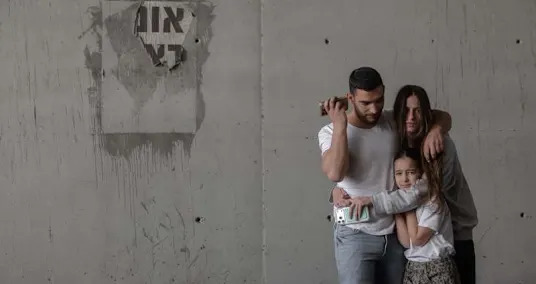
Despite overwhelming public support to fight Iran's Islamic Republic in Operation Roaring Lion, the war is taking its toll on everyday citizens.

It has been over four weeks since Israel and America struck Iran.
With the goal of complete victory and even regime change in Iran, the leadership of both countries taunted a lightning war that would bring decisive change.
Now, a month into the conflict and with Passover arriving, the ballistic missile attacks may have slowed for some, but they are still a constant part of everyday life.
Debilitating restrictions and night disturbances from sirens remain commonplace, even though talks of ceasefires abound in the Israeli press.
More so, with the entrance of Yemen’s Houthis into the war last weekend and the siege of the Strait of Hormuz by Iran very much ongoing as of the time of writing, a lightning victory seems increasingly out of reach.
Voices from a nation at war
Despite overwhelming public support to fight regarding Operation Roaring Lion, the war is taking its toll on everyday citizens.
I have reached out mainly through various online groups and to people on the street to ask how Israel’s population is holding up.
What was discovered is that, with Passover here, the war is viewed through two lenses: the strain of the war and its uncertainty, but with a sense of optimism for a good outcome.

Jerusalem
Yulia Medovoy Edelshtain, a new immigrant from the US, sees the war as part of a much larger regional transformation. She believes the current conflict could reshape the Middle East, particularly if the Iranian regime, which she calls “the head of the snake,” falls.
Drawing on conversations with Persian friends abroad, she views the war as both necessary and potentially historic. Yet even with this optimism, she remains wary of any ceasefire.
In her view, the current Iranian leadership cannot be trusted, and only a “complete dismantling of its capabilities would usher in a safer future.”
For Arnie Draiman, a longtime Jerusalem resident, the war is felt most in the disruption of everyday life. “It’s been much harder to socialize,” he said. “Even seeing family that lives in different parts of the country has become difficult.”
He pointed to practical challenges as well: “It is very difficult to use public transportation, since the frequency of the buses has been cut back significantly; it’s a real burden getting to and from work.”
The years he has lived in Israel have turned him into a realist, with an occasional pessimistic undertone. “I’ve lived in Israel for 41 years and have seen many wars. It seems that we never truly finish a war... It [always] comes back to bite us worse than before.”
Nevertheless, he is an optimist, and he leaves room for possibility. “Change is possible if we can really do the job right,” Draiman said.
Sandra Marcantonio, from Ein Kerem, captured the emotional tension many feel when considering the possibility of a ceasefire. “I will feel torn,” she admitted.
“On the one hand, it’s crucial to ensure that the goals of this military campaign are achieved. On the other hand, I want to live a normal life.”

Central Israel and the North
In the central region, where daily life has been repeatedly interrupted by missile alerts and displacement, the tone shifts toward exhaustion and emotional toll.
Anglo-Israeli writer and documentarian Melanie Preston described the war as physically and mentally draining. Sleep deprivation and stress have taken a tangible toll on her health, forcing her to flee southward during intense barrages.
Beyond the physical strain, she spoke of a different kind of fatigue, one rooted in social and international backlash. “I’m tired of all the hate I receive,” she said, pointing to the international and social pressures that accompany the conflict.

Oren Karev from Tel Aviv expressed a dual reality – exhaustion alongside a sense of life. “I feel exhausted by the war and the pressure to keep going, yet Tel Aviv keeps breathing.”
Between sirens, life carries on in a surreal rhythm, with people clinging to routine and small moments of normalcy. He said, “The city and its liveliness are what give us energy to keep going.”
Joshua Buchalter, also from Tel Aviv, has a more optimistic outlook. “There’s a lot of uncertainty about where the war is going, but I have no doubt the Middle East will be a better place for everyone within the foreseeable future. May the Abraham Accords expand.”
Farther North, in the Krayot just north of Haifa, Ronit takes a more critical stance on the broader geopolitical narrative. Perhaps speaking to exhaustion from constant missile attacks and global public opinion, she’s had maybe one good night’s sleep in two weeks.
“We are in and out of the mamad [safe room], sometimes multiple times a night,” she said. Ronit is afraid, especially of the possibility that the situation of constant alerts and sirens will continue to repeat itself.
“We don’t know what will happen next,” she said, referencing shifting attitudes abroad. “You see what is happening with the American public? What is Iran to the American public? They want cheap gas.
“What sort of existence is this,” Ronit wondered, “having to go through these states of emergencies again and again?
“We want a normal life.”
The experts weigh in
As the war continues to unfold, Israeli security experts caution against simplistic narratives, emphasizing both the scale of achievements and the limits of what military force alone can accomplish.
Brig.-Gen. (res.) Yossi Kuperwasser, head of the Jerusalem Institute for Strategy and Security (JISS), said: “Life is complicated, [but] everyone wants simple solutions.” Rather than look at the matter this way, he recommended, it is best to see that significant progress has been made.
“What we are managing to accomplish, to a large extent, is the destruction of Iran’s ability to construct nuclear weapons, and the decimation of its ballistic missiles.”
According to Kuperwasser, the broader impact is already visible. “The threat that Iran will pose will be degraded for a long time,” he estimated, noting that “the most important targets were hit, and now we are moving to less important ones.”
He regards strikes on sites like the Islamic Republic’s military complex Parchin, which he described as “critical for the production of nuclear weapons,” as examples of less important targets currently being handled.
Kuperwasser stressed that these developments must be understood in context. “We need to look at this as part of a wider war since Oct. 7.”
“From when we were about to be strangled – now we are hitting them hard,” he said. However, he tempered expectations: “Anyone who thinks this can be done as a free lunch – there is no free lunch.”
Ultimately, he frames the objective not as total elimination of the threat but as long-term deterrence. “The goal is to establish a form of strategic deterrence, so that the Iranians will be hit so hard that they will not be able to threaten Israel again with nuclear weapons or missiles.”
Even then, he cautioned, “There is no guarantee that we won’t need to redo the war again if Iran renews its capabilities.”
A mix of realism and measured optimism was also shared by Maj.-Gen. (res.) Yaakov Amidror, who was unequivocal about the current balance.
“No question, [they are] getting out of this war much weaker,” he said in reference to the degradation the Islamic regime is currently undergoing. “They will have many more problems going back to their projects.”
To Amidror, who is a senior fellow at Anne and Greg Rosshandler at JISS, Iran’s weakened military posture points to the strength in which Israel finds itself.
“They have the ability to launch a dozen missiles, while we fly hundreds of sorties a day. They do not have a navy to project power in the Gulf or the Mediterranean,” he detailed, adding that debates over Israel’s ability to strike Iran are now settled.
“These silly questions won’t be asked anymore.”
At the same time, he identified unresolved risks. “One big problem is the enriched uranium inside Iran.”
Working alongside the US, Amidror said he cannot promise a future certainty of peace, but added that Israel has achieved significant results.
“We destroyed not only the missile project but also military infrastructure in Iran.”
Yet, he echoes Kuperwasser’s caution: “Can they go back to the project? Yes. Will it cost them much more? Yes. Will it be more complicated? Yes.”

How society is coping
According to Prof. Noa Vilchinsky, head of the Psycho-Cardiology Research Lab at Bar-Ilan University and the co-founder of a resilience center established after Hamas’s Oct. 7 massacre, the core challenge is uncertainty itself.
“Uncertainty is one of the hardest things for a person to deal with,” she said.
“Now we are in a situation where we do not know what is happening with the war... whether we will sleep at night... how many sirens there will be and why.”
That constant unpredictability has created what Vilchinsky described as a deep and ongoing strain. “This causes us to drain our personal resources.”
The Israeli experience, she noted, is particularly intense.
“We have been in a situation of uncertainty for six years now,” she said, listing the COVID-19 pandemic as the start of this situation, through repeated wars, and now renewed escalation.
The impact is visible across society. “It affects us: We have more chronic diseases, more accidents on the roads, more domestic violence, more addiction, and less work efficiency.”
That stress is not only emotional – it is also physical. “There is a 20% rise in stroke rates since Oct. 7,” alongside “many more people having heart problems,” Vilchinsky said.
Additionally, basic rhythms of life have been disrupted. “We don’t sleep. When we don’t sleep, our bodily systems deteriorate, our mind doesn’t work the way it needs to, and we lack patience.”
On the personal level, the burden is relentless. Beyond work, children, and family responsibilities, there is now “a huge amount of fear: ‘Will we die?’... ‘Will our home get destroyed?’... ‘Will we have work?’”
The financial cost is immense, and this has been the case even before the current war: “100 million shekels a year extra is what the social ramifications of the war cost us,” Vilchinsky said.
Over time, these pressures accumulate. “We see a rise in divorces... the mental resources of people collapse. We become upset, and this comes out on the people around us.”
Despite the weight of the challenges mentioned above, Vilchinsky emphasized that resilience is not about eliminating fear but managing it.
“At the simplest level... we are allowed to feel frustration and fear. It completely matches the situation,” she said. Rather than suppressing emotions, she encourages self-compassion.
“Give credit to yourselves; you are allowed to be upset; you are allowed to forgive yourself,” she advised. Give yourself a self-hug – it’s not you, it’s the situation.”
Physical activity plays a key role here.
“Sports is one of the best stress relievers... a stress killer. It reduces levels of depression,” Vilchinsky said.
Equally important is human connection. “Social assistance is the most important thing – to speak to people – for a feeling of not being alone.”
She added that helping others can be just as powerful: “The feeling of supporting someone adds more meaning to life.”
Routine, too, becomes a stabilizing force. “To be busy – cook, watch movies, work on your hobby – ensures that you create a routine you can handle and... return back to it,” she advised.
For those experiencing more severe symptoms, she was clear: “Seek professional help. This is perfectly okay and normal.”
In essence, seeking help one day and providing help on another is a sign of resilience itself, as she emphasized: “Resilience does not mean you are strong all the time. It means that it is hard and that it is sad that you manage and bounce back, know how to bend, and then rise again.”
For all the aforementioned effects of the state of emergency, Vilchinsky ended on a note of cautious strength.
“Look at how society does not collapse,” she said. “People crash today but rise up tomorrow. People go on reserve duty again and again. Parents raise their children and continue to work.”
When examining her own students’ behavior, moreover, she sees resilience everywhere. “Students are eager to study. And they attend classes even under missile attacks. This is remarkable,” she marveled.
Lastly, Vilchinsky pointed to something deeper than endurance: “We are raising the next generation of leaders who will have resilience, who will know how to fall one day but rise up stronger the next.
“This spirit keeps this country going – preserving our culture and way of life as we pass it on to the next generation.”
A modern-day Passover message
Dr. Cathy Lawi is the founder and CEO of EmotionAid, an NGO that provides emotional first aid to those suffering from the effects of intense stress and trauma. She said she has seen how society has been shaped by the traumas of the past few years.
“Our sense of purpose is connected to the human experience,” she stated.
“We have a built-in system to keep safe. Two layers of parameters are built in,” Lawi said. The first is a sense of safety and how our individualism is shaped in the collective.
The second, she noted, is that “we have been holding the paradox of not being safe but still living life to its fullest, no matter what, even if safety cannot be guaranteed.”
Passover, from this point of view, very much resonates with how we view ourselves as a Jewish society, even if it will feel like a different holiday this year.
“On the one hand, maybe we cannot feel the usual joy that we feel with the holiday. At the same time, the very deep meaning of reading the Haggadah will be felt more deeply,” Lawi said.
While this remains individual, the sense of connection to our culture and roots is essential to our happiness. According to Lawi, this blend of the individual and the collective is key.
In one respect, we will have the drive to create a start-up that will change the world, she said. In another, she continued, we will gather around the Seder table and tell the Seder story to our children, even if it will be in a bomb shelter, to keep a sense of calm and purpose.
Regardless of our drive to be called “Westerners,” this unique combination makes us stand out as a society. And, notably, despite two and a half years of war, Israel remains the eighth-happiest country in the world.
“The paradox is that we are holding many pieces that do not necessarily exist in the Western world,” the doctor said.
Passover, according to Lawi, is about the narrative of an oppressed people who took matters into their own hands and became free, sitting together, all sharing a similar collective fate.
“When we talk about narratives in our societies, we are very good at giving dramatic narratives. There are different cultures of narratives,” she said.
“For Passover, we have the culture of dignity. It will allow us to dwell on the fact that we were victims, enslaved people in Egypt, and that we took our destiny into our own hands.
“We went through the desert, on our own journey, a journey of discovery, and we gelled as a people. We are feeling that very strongly these days, including with the Jews in the Diaspora.”
The feeling of connectedness is also bringing Diaspora Jews, who themselves are facing a resurgent antisemitism, closer to Israel.
“They are constantly checking on us – that is, with their own environment of antisemitic attacks. There is a feeling that we are getting back together as a people,” Lawi reflected.
So, this Passover, it is important to remember not only who we are as a people but also that we have a long history of overcoming adversity.
Regardless of how long the war will actually take, it is showcasing a strong sense of resilience among a society that wants to live and to overcome.
For all the hardships, this year Passover will likely be as meaningful as ever as we remember who we are as Israelis and as Jews.
LATEST POSTS
- 1
 Figure out How to Consolidate Cutting edge innovations in Senior's SUVs
 - 2At least 171 measles cases confirmed in 9 states, CDC data shows
- 3Cannabis reclassification could 'open the floodgates' for research, scientists say
- 43 Must-Change Settings for iPhone Clients: Safeguard Yourself !
- 5Step by step instructions to Prepare with Senior Protection for Inward feeling of harmony.




- Qantas and Virgin Australia Ban Power Bank Usage on Flights Following Safety Incidents
- ‘RichTok’ Influencer Becca Bloom Shows Off Custom Invitations and ‘Most Valued Possession’ from Her Viral 2025 Wedding
- Fuel Price Spike Drives Surge in Used EV Sales in Europe
- This star-forming galaxy is blowing out powerful winds topping 2 million mph
- Figure out How to Get the Most Familiar Drive for Seniors in SUVs
- Moderna to complete US mRNA manufacturing network with $140 million investment
- Vote in favor of Your #1 4\u00d74 SUVs
- Inconceivable Spots To Stargaze All over The Planet
- Decrease in Home Buy Credits and Home loan Renegotiating Rates: An Outline of Latest things