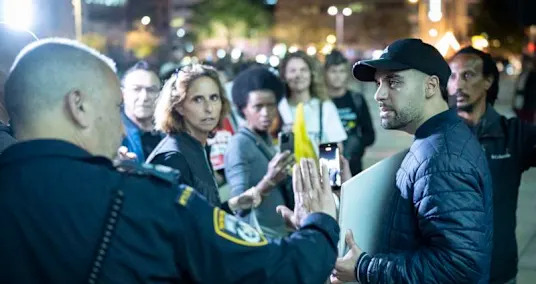
Protests took place in Tel Aviv, Jerusalem, Haifa, and Beersheba, as a survey found broad but uneven support among Jewish Israelis for Operation Roaring Lion.
Israel Police arrested 21 anti-war protesters Saturday night as demonstrations against the conflict with Iran expanded in multiple cities despite restrictions on public gatherings.
Protests took place in Tel Aviv, Jerusalem, Haifa, and Beersheba, with hundreds of participants reported in Tel Aviv and Jerusalem and about 100 in Haifa, marking the largest turnout since weekly demonstrations began. Authorities said 13 people were arrested in Tel Aviv and eight in Haifa.
Police said the gatherings were not approved under Home Front Command regulations that ban events with more than 50 people. Officials said the increase in turnout followed calls by groups opposing the government to protest despite the restrictions.
“During a situation assessment that took place at the scene with a Home Front Command representative… it was clarified that there was a real risk to human life and accordingly, Yarkon [precinct] police commander Tzachi Sharabi ordered the gathering to be dispersed,” police said.
Hadash-Ta’al chairman Ayman Odeh, an Arab lawmaker involved in the protests, criticized the police response, calling officers fascists “in the service of the government” and saying they were afraid of “the heroic citizens who went out, despite everything, to make their voice heard.”

Survey shows broad, uneven support for war
The demonstrations come as a March 2026 survey by the Israel Democracy Institute found broad but uneven support among Jewish Israelis for Operation Roaring Lion. Support was strongest on the Right at 87% and about half on the Left.
The survey also found that Jewish and Arab respondents largely agreed that Iran’s resilience has been stronger than expected. Most Jewish respondents said Israeli society could sustain the campaign for up to one month, while 28% said as long as needed. Arab respondents were less optimistic about how long the public could endure the conflict.
A majority of Jewish respondents said Prime Minister Benjamin Netanyahu’s decision was driven by security considerations, while most Arab respondents viewed it as political.
LATEST POSTS
- 1
 Three killed as unfinished building collapses on church service in Ghana
 - 2Practice environmental safety in Style: Divulging Famous Electric Vehicle Brands
- 3From Educational Loans to Obligation Free: Independence from the rat race Accomplished
- 4A Republican elected governor in California? It's not as far-fetched as it sounds.
- 5Top 10 Arising Advances That Will Shape What's in store



- Hubble Space Telescope spies dusty debris from two cosmic collisions
- With Obamacare premium hikes, more people opting for no coverage or cheaper plans
- Best Internet based Course for Learning Another Dialect: Which Stage Do You Like?
- Surging measles cases are 'fire alarm' warning that other diseases could be next
- ‘The White Lotus’ sparked online interest in risky anxiety pills, study says
- The Quadrantid meteor shower peaks tonight, but will the full 'Wolf Moon' outshine the show?
- Intriguing Social Unesco World Legacy Locales All over The Planet
- 5 VIP Voice Exhibitions in Energized Movies
- Governors Ball 2026: Lorde, A$AP Rocky and Stray Kids set to headline


