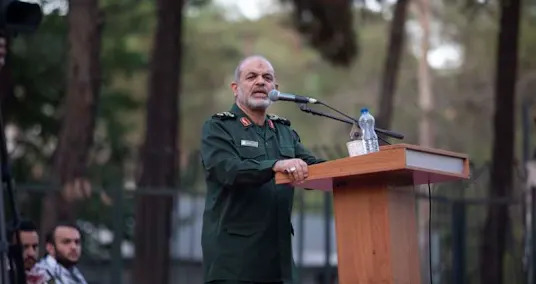
Ahmad Vahidi, a known quantity for Israel and the West, became the face of a regime that prefers total confrontation over any semblance of pragmatism.
In the wake of a seismic shift in the Islamic Republic’s leadership, following the killing of Iranian supreme leader Ali Khamenei and other senior figures, one name has emerged as the definitive architect of Iran’s military and internal survival: Ahmad Vahidi.
As the new commander of the Islamic Revolutionary Guard Corps (IRGC), following the death of Maj.-Gen. Mohammad Pakpour, on the first day of Operation Epic Fury and Roaring Lion, became the face of a regime that prefers total confrontation over any semblance of pragmatism.
Vahidi’s ascent comes at a time of unprecedented internal friction. While President Masoud Pezeshkian attempts to navigate a collapsing economy and deepening international isolation, Vahidi represents the old guard – the generation that rose from the Iranian Revolution in 1979 and never looked back.
“Vahidi is among the first commanders of the Quds Force,” said Nati Tubian, an expert on Iranian affairs. “He is truly flesh of the regime’s flesh – a product of the IRGC’s foundational years who has climbed every rung of the ladder.”
For the West and Israel, Vahidi is a known quantity. A former commander of the Quds Force in the 1990s, he is officially wanted by Interpol for his alleged role in the bombing of the AMIA Jewish community center in Buenos Aires in 1994, which killed 85 people.

Tamar Eilam-Gindin, from the University of Haifa’s Meir and Miriam Ezri Center for Iran and Persian Gulf Studies, said Vahidi’s career serves as a road map of Iranian state-sponsored terrorism.
“The 1990s were characterized by intense Islamic Republic activity in foreign countries,” she said. “There were numerous assassinations on European soil, as well as the major bombings in Argentina. Vahidi was a core part of that operational circle.”
Ahmad Vahidi's history in Iranian politics
Vahidi was appointed defense minister in 2009 under then-president Mahmoud Ahmadinejad. As interior minister in 2022, he played a key role in the brutal suppression of the “Woman, Life, Freedom” protests following the death of Mahsa Amini.
“As interior minister, he was responsible for the logistics and ‘security’ of the regime, which in practice meant the systematic crackdown on civilians,” Tubian said. “He is a fundamentalist with Iranian blood on his hands.”
Inside the halls of power in Tehran, Vahidi’s hardline stance has put him on a collision course with Pezeshkian. As the Iranian economy teeters on the brink of collapse, Pezeshkian has hinted at the need for a tactical retreat or a ceasefire to appease an increasingly angry public.
“If there’s no ceasefire within three weeks or a month, Iran’s economy might completely collapse,” Pezeshkian said in a debate with Vahidi, according to London-based Iran International, an anti-regime, Persian-language news channel, reflecting the desperation of the reformist wing.
Pezeshkian even went so far as to issue a rare public apology for IRGC provocations against Gulf states.
“On my own behalf, I apologize for this process and the situation that has occurred,” he said.
Vahidi, however, remains unmoved.
While Pezeshkian apologizes, Vahidi’s IRGC continues to launch attacks against Gulf states, signaling to the world, Iran’s neighbors, and the Iranian public that diplomats do not hold the reins of power.
“Vahidi belongs to the hardline core that prefers to fight ‘whatever it takes’ rather than accept a ceasefire,” Tubian said.
This sentiment is echoed in Vahidi’s own rhetoric. In a recent address, he said, “Today, we have reached a point that can be called the beginning of great leaps. Our country, in terms of geopolitical and geostrategic characteristics, holds a unique regional and international status.”
Despite his talk of “great leaps,” the sentiment on the streets of Tehran is markedly different. The average Iranian citizen is weary after a decade of near-constant conflict.
“I think people prefer ceasefires,” an Iranian citizen said. “More complex matters should be handled by decision-makers, but no one likes war.”
But in Vahidi’s world, the desires of the citizenry are secondary to the survival of the Islamic Revolution.
Vahidi is not a man who can be easily bargained with, Eilam-Gindin said.
“Unlike the president or the foreign minister, Vahidi cannot be described as a pragmatist or a reformist,” she said. “He is a fundamentalist who believes in the path of resistance above all else.”
LATEST POSTS
- 1
 Airport wait times won't return to normal until Congress reaches a deal to pay TSA. Here's why they still can't come to an agreement.
 - 2Black Friday Paramount+ deal: Save 50% and stream these buzzy Taylor Sheridan shows
- 3Nutrient Rich Organic products: Lift Your Wellbeing
- 4Four countries to boycott Eurovision 2026 over Israel’s inclusion
- 5Find the Standards of Powerful Cooperation: Accomplishing Cooperative energy and Coordinated effort



- Instructions to Pick the Best Course for Your Next Waterway Voyage: Objections, Views, and Social Encounters
- We tasted one of the 10,000 Hershey's Dubai chocolate bars being resold on eBay. Is it worth the hype?
- Figure out What Shift Differentials Mean for Your General Attendant Compensation
- Meet the astronauts about to make history on flight around the moon
- Netanyahu leads meeting on West Bank riots, Katz defends axing administrative detention for Jews
- The Reduced Portage Horse: An Inheritance Reconsidered for Present day Experience
- 10 Activities to Lift Your Consume and Bust Your Stomach
- 'The Beast in Me' arrives on Netflix: Is it based on a true story? And what drew Claire Danes to it? What to know about the thriller series.
- Avoid Slam: Clearing the Street for the Eventual fate of Standard Size Trucks