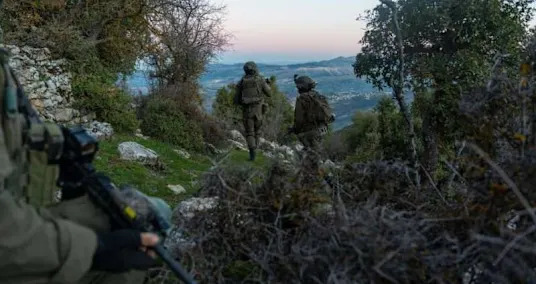
Is Israel prepared to occupy southern Lebanon up to the Litani River on a long-term basis, or is its readiness to hold onto the area a temporary tactic to apply short-term pressure on Hezbollah?
In recent days, top Israeli political officials have largely shifted the goalposts on Israeli policy with regard to southern Lebanon without making clear what the changes fully entail.
In short, is Israel prepared to occupy southern Lebanon up to the Litani River on a long-term basis as it did between 1982-2000 to try to reduce the threat posed by Hezbollah, or is its new readiness to hold onto the area a temporary tactic to apply short-term pressure on the Lebanese terrorist group?
Finance Minister Betzalel Smotrich was the first to speak about the issue in recent days, advocating annexing southern Lebanon – something that is highly doubtful the government would consider.
But on Tuesday, his statement was followed by Defense Minister Israel Katz, who seemed ready to tie seizing southern Lebanon up until the Litani to whether and when Hezbollah would be ready to disarm.
Hezbollah has been dead set against disarming, and there is no obvious way to disarm it without the Lebanese army doing so.

Next, the Lebanese army has shown it remains afraid of the terrorist group, indicating that Katz’s statement, if it reflects policy, could mean holding onto southern Lebanon for years and indefinitely.
Such a position could effectively mean “occupying” southern Lebanon, even if Israel does not formally use the word.
On Wednesday, Prime Minister Benjamin Netanyahu also finally weighed in on the issue.
“We removed the threat of a ground invasion [into Israel from Lebanon] and are further widening the buffer zone,” he said. “We are determined to change the underlying foundations of the situation in Lebanon.”
Netanyahu's statement leaves possibility of extended occupation open
This statement is much vaguer than those by Smotrich or Katz, but the idea of changing the underlying foundations of the situation in Lebanon and of widening the buffer zone leaves open the possibility that Netanyahu might support an extended occupation.
What is the IDF’s professional and apolitical position on the question of occupying southern Lebanon?
First, sources have indicated that the IDF’s position has not remained monolithic but has evolved radically over the past month.
Initially, the IDF hoped that a limited invasion of the first line of southern Lebanon villages, along with increasing airstrikes, would get Hezbollah to stop firing on Israel and get the Lebanese government to act more harshly against the Lebanese terrorist group.
The IDF’s early actions in this war against Hezbollah, while weakening Hezbollah in a broad sense, failed to reduce its rocket fire on Israel at all. In fact, they even led to some increased rocket firing efforts by Hezbollah on some days as it tried to deter the IDF.
At the second stage, sources have indicated that the IDF was ready to move toward the second line of southern Lebanon villages to further pressure Hezbollah and push it farther out of range for firing anti-tank missiles and certain rockets.
This has reduced the anti-tank missile threat and has meant that more Hezbollah rockets have fallen short of Israel, landing in Lebanese territory.
But Hezbollah has still managed to shower the northern border villages with rockets, and sometimes it has struck as far as Haifa and the Lower Galilee.
IDF reluctant to take land in Lebanon
Throughout the war until now, the IDF at nearly all levels has been very reluctant to take over large swaths of southern Lebanon and wanted to stay away from the Litani.
Put simply, the IDF has not forgotten the 1982-2000 experience.
It was a bitter time period, when IDF Chief of Staff Lt.-Gen. Eyal Zamir was coming of age as an officer, and some other top IDF high-command officers also served.
They lost hundreds of comrades in arms over the years and fought countless battles only to withdraw in 2000, with it being unclear exactly what had been achieved by occupying foreign territory for so long.
Holding territory to pressure an adversary sounds like a rational strategy at first.
But tactically holding large areas on a stagnant basis can expose one’s forces to higher chances of being ambushed than in a short invasion in which the ground forces continue to maneuver.
Strategically, Israel will likely be hammered in the diplomatic sphere if it occupies southern Lebanon for any significant length of time.
There was tremendous pressure on Israel to withdraw in the fall of 2024. At that time, in many ways, Israel had a stronger case for wanting to stay longer than it does now, when we have a friendlier Lebanese government and a weakened Hezbollah.
If Hezbollah agrees to some additional measures of disarmament within three months, or maybe six months, such a policy could work.
But if it does not, the IDF is highly concerned about a long-term occupation.
That being said, sources have indicated that the failure of the Lebanese government to rein in Hezbollah, even though it has been trying harder, has switched the IDF into being ready to roll the dice on this issue at least for some period of time.
The tough issue will be if Hezbollah does not disarm, and IDF soldiers start getting frequently ambushed. In that case, the military may want to withdraw, while the political echelon may want to stay longer, even if it has no plan to avoid losing face.
LATEST POSTS
- 1
 Explora Journeys becomes latest cruise line to be impacted by Middle East war
 - 2Scientists detect X-ray glow from interstellar comet 3I/ATLAS extending 250,000 miles into space
- 3BHP liable for 2015 Brazil mine disaster: UK court
- 4Kaiser Permanente affiliates to pay $556 million to resolve US claims alleging Medicare fraud
- 5How a Snake That Eats Cobras Redefined the Meaning of ‘King’



- Vote in favor of your Number one method for praising a birthday
- Party Urban areas of the World
- Melodic Event: A Survey of \Energies and Exhibitions Assessed\ Live concert
- How color-changing, bacteria-infused spacesuits could help keep future astronauts safe from space radiation
- Viable Correspondence: Building Solid Connections
- Four Dead in Last Month From Animal Attacks in Nepal
- SpaceX launches Starlink satellites from California on 160th Falcon 9 flight of the year (video)
- Interstellar comet 3I/ATLAS' journey through our solar system, in photos
- What to know about Jack Dorsey's new Vine revival, DiVine


