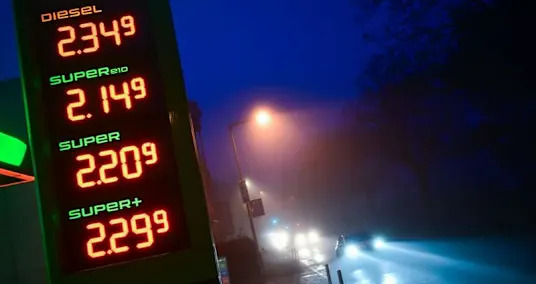

A new rule to limit fuel price hikes took effect in Germany on Wednesday, limiting petrol station to raising prices no more than once a day in a bid to bring down costs for motorists amid a surge in oil prices caused by the Iran war.
Under the new restrictions, petrol stations are only allowed to raise prices once at midday to limit price fluctuations and ensure greater transparency. Price reductions will still be allowed at any time.
Prices went up by as much as €0.2 ($0.23) per litre at noon (1000 GMT) but the hikes varied across petrol stations, as observed by dpa reporters.
A station in the northern outskirts of Berlin raised prices by between €0.06 and €0.08.
According to an analysis by motoring organization ADAC, 1 litre of Super E10 petrol was sold at an average of €2.175 across Germany shortly after noon, €0.076 more than shortly before noon.
The average price of diesel rose by €0.075 to €2.376, significantly higher than peak prices recorded on Tuesday morning.
The law was published in the Federal Law Gazette on Tuesday. In adopting the measure, the German government is following Austria, where a similar rule has been in place for some time and was recently tightened.
The ADAC and petrol station operators have expressed doubt that the new regulation will have a major effect.
Violations of the new rule can be punished with fines of up to €100,000 ($115,700). The "fuel measures package" also includes tougher antitrust rules. Germany's Federal Cartel Office will be given more powers to act against excessive prices.
Monika Schnitzer, a leading economist, warned against further intervention to bring down fuel prices, instead calling on drivers to cut down on trips.
Noting that the closure of the Strait of Hormuz has led to a shortage of oil, "people need to think about where it’s really essential to drive, where they can do without it, where they can carpool, and where they might be able to use public transport," she told public broadcaster ZDF.
Schnitzer, who is part of the German Council of Economic Experts, a five-member council also known as the "Five Sages" that advises the government on economic policy, also advocated for the current situation to be taken as an incentive to accelerate transition to renewables.
"We need to become less reliant on these fossil fuels," said Schnitzer. It was clear "that the best way out of this situation is to focus all our efforts on expanding renewable energy," she said.
LATEST POSTS
- 1
 Move. Cheer. Dance. Do the wave. How to tap into the collective joy of 'we mode'
 - 2Mont Blanc road tunnel reopens to traffic after 15 weeks of repairs
- 3What an expert on the gut microbiome eats in a day
- 4The Developing Nearby Food Development and Its Advantages
- 5Figure out How to Advance Space in Your Pre-assembled Home for Upgraded Usefulness





- The most effective method to Pick the Ideal Shrewd Bed for Your Special Rest Needs
- Israel Police arrest twenty-one as anti-war protests grow despite broad support for Iran war
- Tech for Efficiency: Applications and Apparatuses to Accomplish More
- Flu season is ramping up, and some experts are "pretty worried"
- Instructions to Amplify Certifiable Experience While Chasing after an Internet Advertising Degree
- King Charles shares cancer treatment update, says it's a 'personal blessing'
- 8 key takeaways from Savannah Guthrie's 'Today' interview on the disappearance of her mother
- Sea level doesn’t rise at the same rate everywhere – we mapped where Antarctica’s ice melt would have the biggest impact
- Farmers worry about rising cost of fertiliser